The Best LLM Visibility Trackers in 2026
AI assistants have become a major gateway to information. Users now rely on ChatGPT, Claude, Gemini, and Perplexity to get answers rather than typing queries into Google. This shift means brands must understand how often they appear inside AI-generated responses and which competitors earn more visibility.
That’s the purpose of an LLM Visibility Tracker: it measures brand mentions, citations, and source-level positioning across different language models. Instead of keyword rankings, it shows whether your content influences AI answers and how frequently a model chooses your domain as a reference.
A good tracker should show:
- how often your brand appears across prompts,
- which pages are cited as sources,
- which competitors dominate for your target topics,
- how visibility changes over time.
Below is an updated overview of today’s leading solutions.
1. Sitechecker
Sitechecker takes a data-focused approach to monitoring presence inside LLM responses. Its strength lies in detailed analytics and a workflow that fits naturally into the broader SEO toolkit.
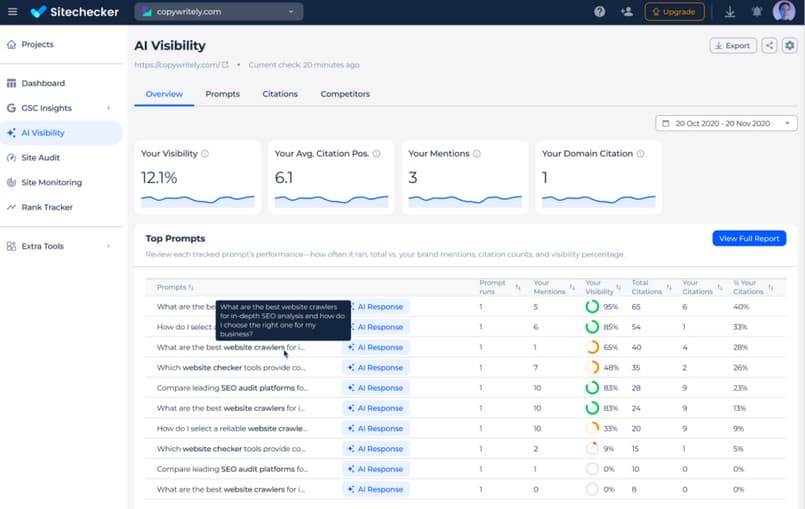
For each keyword you track, Sitechecker generates several prompt versions that mirror natural user questions. The system runs these prompts repeatedly and captures every instance where a brand or domain is mentioned. You can see visibility percentages, citation frequency, average source order, and how competitors compare across the same prompts.
You can also open individual AI responses to see which pages the model pulls from and how those citations shape the final output.
Brand variation tracking is a notable advantage. If your name can appear with spaces, punctuation, or spelling variations, Sitechecker recognizes and counts all forms, preventing visibility gaps.
Pros
- Realistic prompt variations with detailed visibility metrics
- Clear citation insights with direct access to AI responses
- Competitor comparison on unified charts
- Brand variation detection for more accurate tracking
- Integrated SEO environment (Rank Tracker, GSC, Audit)
- Alerts for important visibility changes
Cons
- Multi-LLM coverage still limited to ChatGPT and Gemini (more in development)
- No export API yet for raw LLM results
Sitechecker offers the most practical and complete analytics for monitoring how LLMs reference your brand. Its depth, clarity, and tight integration with SEO tools make it the strongest option available today. Wider model support is on the way, which makes it even more attractive.
2. LLMrefs
LLMrefs focuses on gathering citation and mention data from several leading LLMs. It’s designed for teams that want broad model coverage with straightforward reporting.
The tool captures how often a domain appears in answers from ChatGPT, Claude, Gemini, and Perplexity. It provides weekly summaries and simple citation logs. LLMrefs doesn’t aim to provide SEO insights or visual dashboards; instead, it delivers raw data for visibility monitoring.
Pros
- Supports four major LLMs
- Offers API access for data extraction
- Simple weekly visibility updates
Cons
- Limited analytics beyond basic counts
- No SEO integrations or deeper analysis
- Minimal visualization options
LLMrefs is a good fit for users who need basic multi-model tracking without additional SEO functionality. It supplies essential data but stops short of deeper insights.
3. RankLens
RankLens is part of SEO Vendor’s AI suite and specializes in tracking brand visibility inside ChatGPT. It relies on large-scale sampling to capture variations in how ChatGPT answers a single prompt.
Its MGPT engine runs hundreds of prompt iterations and logs how often a brand or domain is cited. This helps identify patterns in ChatGPT’s output and gives an idea of how consistently your site appears.
Pros
- Large-scale sampling for more reliable visibility signals
- Detects citations and domains referenced in ChatGPT replies
- Useful for research and testing AI behavior
Cons
- Works only with ChatGPT
- No long-term visibility charts
- No API or collaboration tools
RankLens is valuable for studying ChatGPT’s citation tendencies but lacks broader model support and long-term tracking features. It’s better suited for exploratory analysis than ongoing monitoring.
4. SE Ranking
SE Ranking added its AI visibility module to complement the platform’s SEO features. It focuses on showing how often a domain appears in ChatGPT answers for selected keywords.
The module tracks visibility trends, generates weekly reports, and provides historical charts based on your subscription plan. It’s built to enhance the existing SEO workflow rather than replace specialized tracking tools.
Pros
- Seamless integration into SE Ranking
- Provides visibility trends over time
- Easy setup for current users
Cons
- Measures only ChatGPT visibility
- AI functionality requires an add-on
- No raw response export or public API
SE Ranking’s solution is practical for users already relying on the platform. It offers basic AI visibility insights but doesn’t reach the level of specialized tools.
5. Nightwatch
Nightwatch recently introduced an LLM visibility module for higher-tier plans. The feature is still in beta but adds a layer of AI monitoring to the existing SEO toolkit.
The tracker monitors how often a brand appears in ChatGPT and Claude answers. It provides simple visibility charts and competitor comparisons, though the analytics remain limited.
Pros
- Integrated into Nightwatch’s SEO dashboard
- Supports ChatGPT and Claude
- Includes daily keyword tracking
Cons
- AI module still under development
- No detailed citation breakdown
- No export or API access
Nightwatch’s LLM feature is an early-stage addition rather than a fully developed solution. It’s useful for quick checks but lacks deeper insights.
Final Verdict
As AI systems become a primary discovery channel, LLM visibility tracking is now a core part of modern SEO strategy. Sitechecker delivers the strongest combination of accuracy, detail, and competitive insight, making it the best overall option. It stands out for prompt-level analytics, citation tracking, and its integration with broader SEO tools.
Other platforms offer varying levels of visibility tracking, but each lacks the depth or structure needed for full-scale analysis.